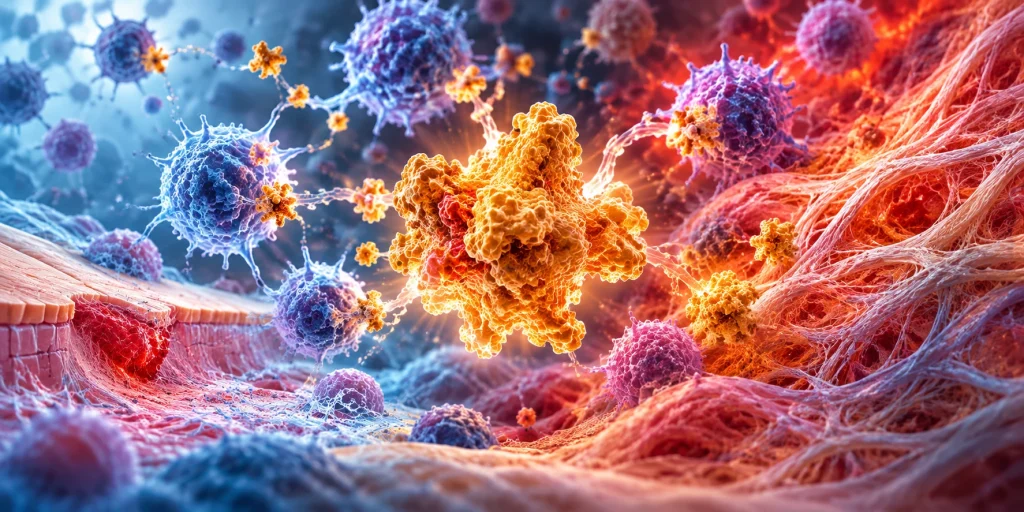
Galectin-3 is a small protein the human body makes on its own. It belongs to a family of about fifteen related proteins called galectins, all of which share one basic talent: they recognise and grip particular sugar patterns. That sounds like a minor skill. In practice it is how a great deal of cellular housekeeping gets organised — which cells stick to which, how signals are held on a membrane long enough to be heard, and how the immune system is told that something needs attention.
Galectin-3 has drawn far more research attention than its relatives, for two reasons. It is built differently from the rest of the family, and it shows up in the blood of people with a striking range of conditions — heart failure, chronic kidney disease, liver fibrosis, autoimmune disease, several cancers and a number of neurological disorders. That has made it one of the more closely studied proteins in modern medicine, and one of the more frequently misunderstood.
A Protein Built Differently From Its Relatives
Every galectin carries at least one carbohydrate-recognition domain — the part that does the sugar-binding. Most members of the family are put together in one of two straightforward ways: a single recognition domain that pairs up with a copy of itself, or two domains joined by a short linker.
Galectin-3 is the only human galectin built to a third design. It has one recognition domain attached to a long, flexible tail, and that tail is what makes it unusual. Because of it, galectin-3 molecules can link together into larger assemblies rather than staying as single units or simple pairs. A protein that can cluster is a protein that can organise a surface, and that structural quirk explains most of what galectin-3 goes on to do. At roughly 30 kilodaltons it is a modest piece of machinery with an outsized reach.
Where Galectin-3 Is Found
Most proteins have one address. Galectin-3 has several, and its job changes depending on where it happens to be:
- In the nucleus, where it takes part in processing genetic messages before they are translated into protein.
- In the cytoplasm, where it influences whether a stressed cell repairs itself or shuts itself down.
- In mitochondria, the compartments that handle a cell’s energy supply.
- On the outer cell surface, where its sugar-binding side faces outward and it begins organising receptors.
- Outside the cell entirely, released into surrounding tissue and into the bloodstream.
This is worth holding on to, because it is the root of most confusion about galectin-3. When a study reports that levels are “elevated,” it usually means the amount circulating in blood or appearing in urine. That figure says nothing about which tissue released it or which of these jobs it was doing.
What It Does When Things Are Working
Galectin-3 is not a malfunction. It is part of normal physiology, and the body would be worse off without it. It helps immune cells find their way to an injury and switches macrophages — the cells that clear debris — into an active state. It contributes to antimicrobial defence. It plays a part in building new blood vessels, in guiding cell division, and in the repair work that follows tissue damage.
Short-term, local, and then switched off, that is a healthy response. The difficulties described in the research literature are almost always difficulties of duration rather than of the protein itself. A repair signal that keeps firing after the repair is finished stops being repair and starts being remodelling.
The Lattice On The Cell Surface
The mechanism that gets discussed most often is the one that follows from galectin-3’s ability to cluster. When several molecules link up on the outside of a cell, each gripping a sugar structure on a different surface protein, the result is a loose mesh — usually called a lattice.
That mesh behaves a little like temporary scaffolding. It holds receptors in position, slows the rate at which they are pulled back inside the cell, and decides which ones sit close enough together to influence one another. The practical effect is on timing: a signal caught in the lattice is heard for longer than it otherwise would be. Whether that is useful or harmful depends entirely on which signal it is and how long it stays.
Why It Turns Up In Blood And Urine
Cells under stress release galectin-3 readily, and cells that are injured or inflamed release more of it. Once outside, it circulates. It can be measured in a blood sample using a standard laboratory technique, and it also appears in urine.
That measurability is the whole reason for the clinical interest. A protein released early by stressed tissue, detectable with an ordinary blood draw, is exactly the shape of thing medicine looks for in a biomarker — a signal that something is under way before symptoms have made it obvious. In heart failure this has gone furthest: a galectin-3 blood test has been cleared for use in the United States to help assess risk, and American cardiology guidance has acknowledged it, though European guidance has not adopted it. Research has also examined it in kidney disease progression, liver fibrosis, rheumatoid arthritis, lupus, systemic sclerosis, several cancers and a range of neurological conditions.
Where The Picture Gets Complicated
An honest account of galectin-3 has to include the parts that do not resolve neatly, and there are three of them.
It is not specific to any one disease. A raised level tells you that inflammation or tissue remodelling is happening somewhere. It does not tell you where, or why. That is why researchers generally treat it as one input among several rather than a test that stands on its own.
A blood level is a total, not a location. Because so many cell types can release galectin-3, a circulating figure is the sum of everything happening at once. Studies have found cases where the amount in a particular tissue and the amount in the bloodstream do not track each other well.
Animal studies sometimes point in opposite directions. In several models of kidney injury, mice lacking galectin-3 were protected from damage. In other kidney models, the same mice fared worse. The most reasonable reading of that is not that one result is wrong, but that the protein’s effect depends on the stage and severity of the injury — helpful at one point in the process, unhelpful at another.
What A Galectin-3 Result Does Not Tell You
Because galectin-3 appears in so many research headlines, it is easy to treat a number as a verdict. It is not one. A galectin-3 measurement is not a diagnosis, it does not identify which organ is involved, and on its own it does not establish that anything needs treating. Interpreting it is a clinical job, done alongside a history, an examination and other tests, by someone who can see the whole picture.
If you have had galectin-3 measured, or you have read something about it that concerns you, the conversation to have is with your own clinician rather than with a search engine.
Why This Appears On This Site
AquaLink uses plant polysaccharides whose structures include galactose-containing branches, and galectin-3 is named on this site because that shared chemistry is part of why those particular fibres were chosen. That is the extent of the connection. AquaLink is a wellness beverage. It is not a treatment for any condition, it is not offered as a way to change a galectin-3 level, and nothing on this page should be read as suggesting otherwise.
Further Reading
For a closer look at the lattice and the signalling pathways involved, see Understanding Galectin-3. For what the research says about sustained elevation, see The Dark Side of Elevated Galectin-3. For the same idea told without the technical vocabulary, see the hidden switch that turns healing into lasting damage. The Science section explains how AquaLink relates to this research, and the FAQ answers the questions that come up most often.
Source
This article was written from Hara A, Niwa M, Noguchi K, Kanayama T, Niwa A, Matsuo M, Hatano Y, Tomita H. “Galectin-3 as a Next-Generation Biomarker for Detecting Early Stage of Various Diseases.” Biomolecules, 2020;10(3):389. doi:10.3390/biom10030389. Published open access under a Creative Commons Attribution 4.0 licence. The text above is an original summary and explanation; it is not a reproduction of the source.
Educational information only. This article is for general education and is not medical advice. AquaLink is not intended to diagnose, treat, cure or prevent any disease. Always consult a qualified healthcare professional about any health concern.